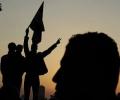
A disparate global network of violent fundamentalist Islamic groups threatens India's eastern flank as much as the north and west with a real possibility of these spilling over into our borders, says Shyam Saran.

'India should think big: About how in a multi-polar world, India can indeed be one of the poles, rather than being a secondary power that has to worry about 'alignment' with one of the poles. A G3 in other words, India should look to getting others to align with itself rather than the US or China,' says Rajeev Srinivasan.

'Devyani -- she is a public servant and her personal life has already received far too much attention -- and her ambitious father now need to retreat to the background so that wiser diplomatic heads restore sanity to India-US relations as India prepares for parliamentary elections,' says Ambassador K C Singh.

Here are some of the most stunning moments of the week that was.

'India is a huge market for Chinese goods. I don't think a war stands to logic when you have economic compulsions, but then Chinese are known to do illogical things.'

'No other terror organisation has valued popular consensus as the Islamic State does -- instead of repressing people, IS wants to gain their support. This is a major innovation in terrorism,' says terrorism expert and author Dr Loretta Napoleoni in an interview to Archana Masih and Syed Firdaus Ashraf/Rediff.com.

Making it easier to do business is a key element of our strategy, says Foreign Secretary S Jaishankar.
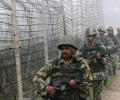
'As India progresses and takes an increasingly hardline approach to Pakistani hostility, the young and restless population of Pakistan, sooner than later, will demand 'Gazwa e Hind' (conquest of India),' warns Colonel Anil A Athale (retd).

'During his visit to Vietnam on September 3 -- the first visit by an Indian prime minister in 15 years -- Modi will notice the widespread anti-China sentiment in that country.'

The winners of the 60th annual World Press Photo Contest have been announced. The winning shot was taken by Turkish Associated Press photographer called Burhan Ozbilici, with an image he has simply titled An Assassination in Turkey. Showing Mevlut Mert Altintas shouting after shooting Andrei Karlov, the Russian ambassador to Turkey, at an art gallery in Ankara, Turkey, on December 19 2016.

There is a great danger of the government getting stampeded into actions in Kashmir that could result in long lasting damage, warns Colonel Anil A Athale (retd).

A list of all the foreign visits taken up by PM Narendra Modi this year and their outcomes.
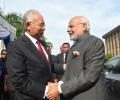
Both countries will advance maritime security and strengthen disaster response in the region, says Modi.
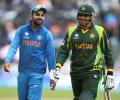
What does Pakistan mean for a young Indian? Devanik Saha attempts an answer.
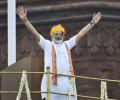
Following is the full text of Prime Minister Narendra Modi's address from the ramparts of the Red Fort on the 73rd Independence Day.

'Xi Jinping got a dose of Modi's medicine inside the tent where he was being hosted on the banks of the Sabarmati river.' 'Modi reportedly told him, looking deep into his eyes: "This was not expected of your country. Can you tell me when the troops are withdrawing?".'

'China refuses to talk to India on nuclear or ballistic missile issues and conclude any de-targeting agreement as Beijing did with Russia or a non-targeting agreement with the US.'
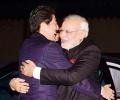
'The regional context and the personal ties between Modi and Japanese Prime Minister Shinzo Abe to a large extent contributed to this dawn of a new era in bilateral relations,' says Srikanth Kondapalli.

King Salman and Narendra Modi will find common ground to intensify cooperation against jihadi terrorism, says Tarun Vijay, MP.

'For so long as the rulers of Pakistan remain committed to confronting and vanquishing India, they will sustain delusions, breed terrorists, and export them.'

But its sales pitch will remain muted till India opens up more seats on the route
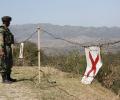
'The response to terror is not always reciprocal terror, nor is launching a conventional response the best response.' 'The best response is to make the sponsor pay a price he cannot afford,' says former RA&W chief Vikram Sood.
'Ensuring through diplomatic means and in conjunction with strategic partners that India will not be required to fight a simultaneous two-front war with China and Pakistan.' Brigadier Gurmeet Kanwal (retd) lists what India must have in its national security strategy.

New Delhi can strengthen its leverage by having better relations with the two than they have with each other.
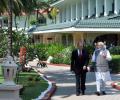
Big ticket defence deals including purchase of missile systems, frigates and joint production of helicopters were sealed on Saturday.

'Pakistan persists in the belief that such attacks will enable it to obtain the territory it covets. Their plans will not succeed.'

'A series of arrests have illustrated that IS now has a footprint in India.' 'India has been, for a very long time, a key part of Al Qaeda's global jihadist ambitions.'

The two countries also asked all nations to stop cross-border movement of terrorists and asserted that a decisive collective response from the international community without 'double standards and selectivity' was required to combat the threat of terrorism.

'It is in the interest of both sides that the visit of the US President is seen as being successful. Both sides have invested considerable political capital in it. This rapid exchange of visits and the decisions taken have to be justified, beyond the symbolism, which is no doubt important in itself. This opportunity to impart a fresh momentum to ties should not be missed,' says former foreign secretary Kanwal Sibal.

Australia's Prime Minister Tony Abbott on Friday said he will sign an agreement with India to sell uranium for non-weapon use. "Prime Minister Modi and I will today sign a nuclear cooperation agreement that will finally allow Australian uranium to India," he said while addressing a meeting, organised by industry chambers including CII and Ficci.
Further deterioration of the US-Saudi relationship will have geo-economic and geopolitical effects, says Nitin Pai.
Prime Minister Narendra Modi's real test will be whether he can bring a longer-term vision to India's foreign policy planning, says Ravi Agrawal.

'The US wants Modi to succeed because we want India to succeed. For our part, when India thinks of its partners in the world, we want it to think of the US first. That means positioning our country as the preferred provider of the key inputs that can help to propel India's rise.' 'The meeting between Modi and Obama is, and must be, an opportunity for true strategic dialogue -- not a scripted exchange of talking points, but an open discussion of the big questions. What kind of world do we want to live in? What are our true priorities? And most importantly, why does this partnership still matter?'

Recognising the threat posed by outfits like the Al Qaeda, Lashkar-e-Tayiba and the Dawood Ibrahim network, India and the United States have agreed to deepen cooperation in fighting terrorism and asked Pakistan to bring to justice the 2008 Mumbai attack perpetrators.
'This is a US-India effort and it is not necessarily to counterweight anyone.'

Here's the full text of Prime Minister Narendra Modi's address to the United States Congress.

Reigning champion India will be bidding to gain further momentum and become only the third side in World Cup history to successfully defend its title after West Indies in 1975 and 1979 and Australia, who won the coveted prize three times in succession between 1999 and 2007.

Ambitious diplomats continue to be attracted to politics but do they make good politicians, asks Jyoti Malhotra

Six Kashmiri Muslim students belonging to Sarhad, an organisation which brings semi-orphans from strife-torn regions to live and study at their school and college in Pune, share their hopes for their state and their experiences outside it. Jyoti Punwani reports.

This is the joint statement issued by the ministry of external affairs on the visit of US President Barack Obama to India.
 © 2026 Rediff.com - Advertise with us - Disclaimer - Privacy Policy - Sitemap - Feedback - About us - Terms of use - Grievances